
Autism spectrum disorders (ASDs) describe a broad category of neurodevelopmental disorders that can pose challenges to an individual’s health over a lifetime. The severity and specificity of clinical features of ASDs can vary from individual to individual, encompassing impairments in cognitive function, general social skills and abnormal sensory processing and/or responses. While the etiologies of various ASDs are not fully defined, the broad consensus holds that both environmental and genetic perturbations are contributing factors. Here we share data from three distinct mouse models of ASDs: FMR1-/y (Fragile X), Cntnap2-/- (Pitt-Hopkins-like Syndrome 1), and Shank3/F (Phelan-McDermid Syndrome), clearly illustrating the deficits in excitatory corticostriatal neurotransmission (correlating to mRNA expression) that are a hallmark of the latter. PsychoGenics offers well-characterized and widely used genetic mouse models of several ASDs, with scientific expertise to help drive progress in your ASD-focused research programs.
Impaired excitatory transmission at corticostriatal synapses of Shank3/F mice
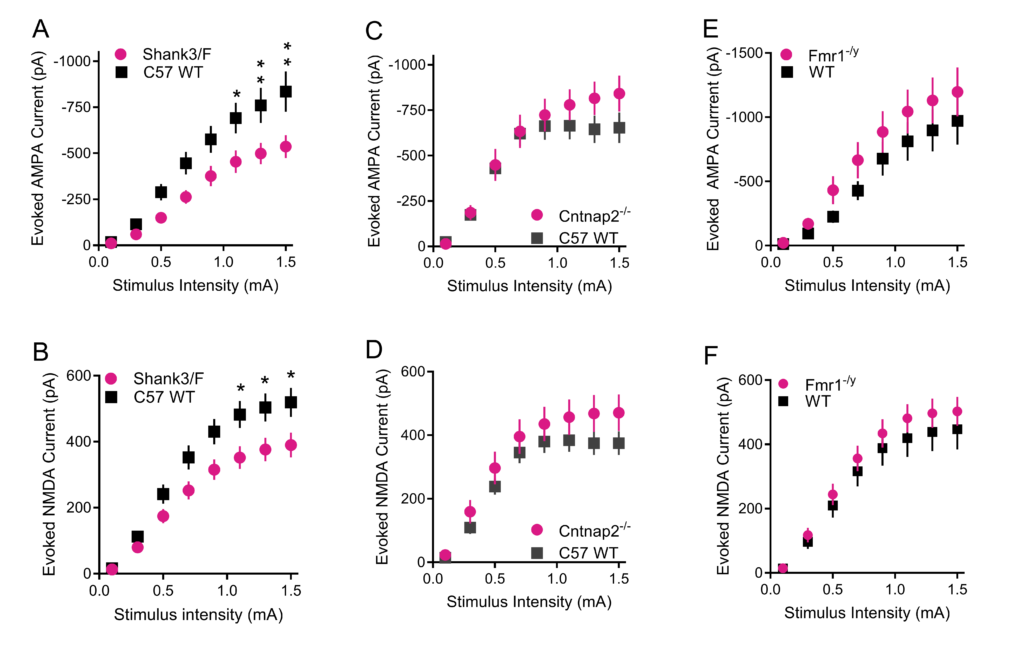
Excitatory neurotransmission is impaired at corticostriatal synapses in Shank3/F mice. Clinical evidence supports involvement of striatal circuits in autism spectrum disorders (ASD) pathophysiology. Shank family proteins are an integral part of postsynaptic density in excitatory synapses. Shank3 is enriched in striatum and its mutations have been linked to both ASD and schizophrenia. Shank3/F mutant mice developed by Guoping Feng show behavioral abnormalities associated with ASD. AMPA- (A) and NMDA- (B) receptor-mediated excitatory postsynaptic currents recorded from medium spiny neurons at corticostriatal synapses were both significantly reduced in Shank3/F KO mice. Similar recordings carried out in contactin-associated protein-like 2 (Cntnap2-/-) mice, a well‑established autism risk model (C, D) and FMR1-/y (E, F) animals did not reveal any significant deficits in these components of excitatory neurotransmission.
Expression of mRNA of proteins critical to excitatory synaptic transmission are reduced in Shank3/F mice
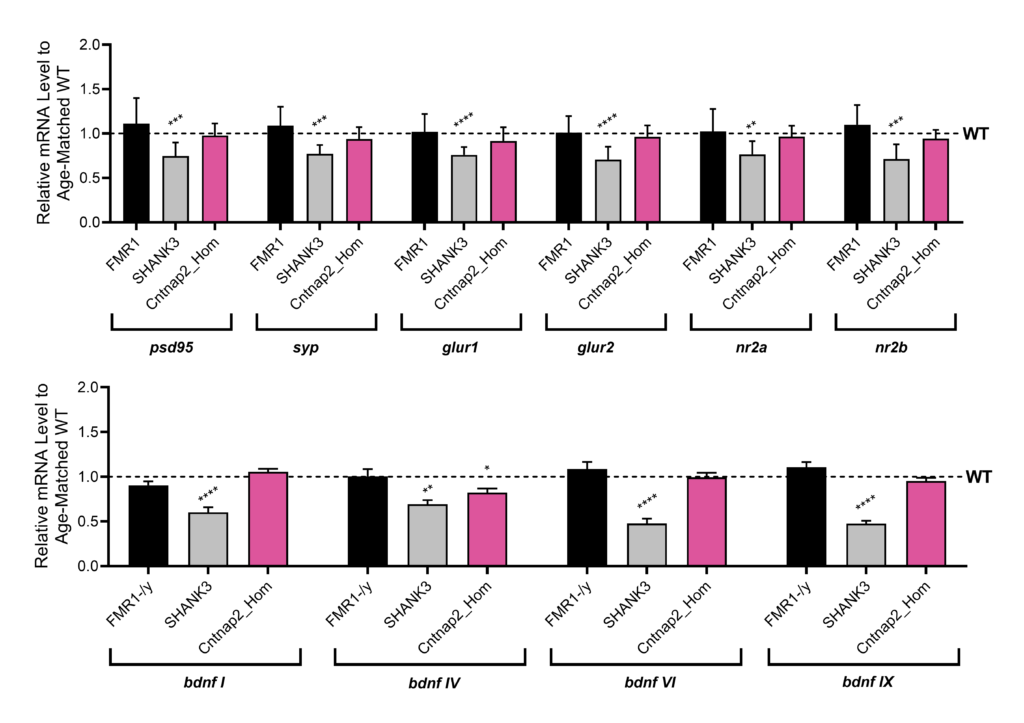
mRNA expression profile of key components involved in the regulation of synaptic plasticity and neurotransmission. RNA from mouse striatum (top) and cortex (bottom) encoding synaptic and glutamatergic transmission markers and plasticity markers (BDNF isoforms) was isolated and reverse‑transcribed into cDNA. Taqman assays for psd95, syp, glur1, glur2, nr2a, nr2b, bdnf isoforms I, IV, VI and IX were run on samples collected from FMR1-/y, SHANK3, and CNTNAP2 mice, and expression levels were compared with wild type controls.